CHERTSEY

BOATS, BRIDGES, BOILERS ... IF IT'S GOT RIVETS, I'M RIVETTED
... feminist, atheist, autistic academic and historic narrowboater ...
Likes snooker, beer, tea, rivets and solitude, and is strangely fascinated by the cinema organ.
And there might be something about railways.
**********************************************************************************

Wednesday, 20 January 2021

Edgar Allen

Apologies for the absence of plant photos yesterday; it is most mysterious. I confess that I was lazy enough to just copy the emails across in their entirety, but when I switched back to my personal account just now and opened the blog in a new tab, they were still there. Anyway, I hope you enjoyed the text. I think with the exception of a few people who must have led very sheltered lives, most people can picture a weeping fig and a money plant - if not, there's always Google.

You might perhaps have wondered about the home from which the plants were eventually evacuated: Edgar Allen House. It sounds quite imposing, doesn't it. In fact it's  PoMo monstrosity occupying a street corner just off prime drunken vomiting territory.

It's nothing to do with Edgar Allen Poe, in case you were wondering.

William Edgar Allen was a steel magnate (of course), and slightly ahead of his (Victorian/Edwardian) time in that he sought to look after his employees when - as appeared to happen with alarming frequency across the industry - they susteined industrial injuries. This included setting up a physiotherapy centre and supporting some pioneering work in artificial limbs.

When the NHS was established they took it over, at some point (presumably in the 1980s) demolished the old Edgar Allen Physical Treatment Centre and build Edgar Allen House.

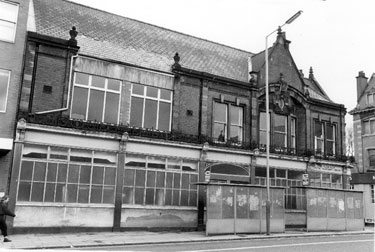
I had always understood that this was on a different site, but this old photo (from the Sheffield Libraries Archive) actually looks like the same site as the current building.Edgar Allen Physical Treatment Centre originally named Edgar Allen Institute from Glossop Road 

You can tell how assiduously I do my research. Anyway, the NHS moved out at some point, and the University bought the building in 2011. We moved in in 2014. It was supposed to be temporary.


Tuesday, 19 January 2021

Plucky plants

I used to work in an open plan office, with about twenty-eight other people, and quite a few plants. Apart from one brief visit in October, I last left the office on March 17th. So did everyone else.  From time to time, one or two people wound wonder what to do about the plants, but by and large we were far more concerned about the students, each other, and getting our teaching and - for me the really big adventure - assessment all online in a really short period of time.

I mentioned that if someone else would fetch the plants, I'd be happy to look after them.

Then it was forgotten again. Only t'Boss had access to the office. I told him I would look after the plants if he would fetch them.

Then nothing happened for a bit. By this point I fully expected all the plants to be dead, which was a bit sad.

Finally, on July 1st, a car double parked in the middle of the road outside my house, and a motley collection of pot plants was quickly offloaded.

They weren't dead. Despite having been left for fifteen weeks in a stifling office, not one of them was dead. To be honest, most of them hadn't been particularly well tended even when we were sharing the office with them, so I ended up repotting every siingle one of them, at the same time as stripping off all their dead bits.

Then I sent an update to all my colleagues, written in the breathless style of a cut-price foreign correspondent:

July 2nd 2020
From your local reporter:
image.png
Finally released after a fifteen week ordeal, the process of recovery can now begin for these brave survivors.

A group of plants found themselves innocent victims of a university's scramble to lockdown in mid-March.

A weeping fig wept as it described how it and its companions thought that they had been abandoned, trapped without food or water throughout the hottest spring on record.

Unbeknownst to them, however, the plucky plants had not been forgotten. Former colleagues, working from their homes across the city, were working on plans to liberate their valued oxygenating companions. Plans which finally came to fruition on Wednesday night, when rescuers finally breached the alarm system and entered the abandoned building.

Sadly, not everyone made it through the ordeal, and the rescue mission occasioned some collateral damage. A money plant told your reporter: 'Don't get me wrong, it was a really great effort, but I'm gutted that some of my shoots got left behind.'

The surviving plants were taken to a secret location in the west of the city, where they are undergoing a careful programme of rehydration.

image.png


A couple of months later, I followed up with a human (OK, vegetable) interest update:

September 1st, 2020

Two months on from their dramatic rescue, we catch up with the plants of Edgar Allen House

image.jpeg

Sun streams into a light airy attic; a gentle breeze wafts across a group of plants basking beneath the open Velux. A cluster of spider plants, looking green and vigorous, huddle together; two venerable money plants watch indulgently over a tray of cuttings; an amaryllis relaxes in the corner. The scene looks idyllic, and a far cry from just two months ago when the plants, dehydrated and terrified, were snatched in a daring raid from locked down Edgar Allen House.

On arrival at the reception centre the exiles were given new pots, compost and water, and, above all, time to recover from their ordeal.
image.jpeg

The weeping fig, who told me in July of their terror at having felt abandoned by the authorities, now shyly shows off its new leaves. One of the most vulnerable of the plants, staff at the reception centre had initially feared for its life, but the slow process of recovery has begun.

When I last spoke to the money plant, it had expressed concern at the way the rescue had been managed. What does it think now?
image.jpeg

'The operation was particularly tough for us' it told me. 'We had a lot of casualties. But, you know, it had to be done. To be honest, it cleared out some of the dead wood. But we lost a lot of youngsters too that day. Those that came through though ... they're stronger and more independent than ever. The money plant community will be fine.'

Some of the rescued plants have moved on from the reception centre. One spider plant told me about its new home in a bathroom.
image.jpeg

'I do miss the intellectual cut and thrust,' it said, from its position on the windowsill, 'But the humidity is awesome.'

Another has been lucky enough - along with its twenty-seven offspring - to find a place in a study.
image.jpeg

'This is the sort of office I always dreamed of,' it sighed. 'Of course, I miss the others, and I know I will go back to Edgar Allen House one day. But a lot of the little 'uns will be putting down roots and staying here, I'm sure of it.'

All the plants agreed that their place was at Edgar Allen House, and most were anxious to return. The amaryllis said 'It's not easy being a university office plant - the heating, the air conditioning, the postmodern angst ... but it's what we know. Some of us have done it for generations. It's not just a job, it's a way of life.'


Monday, 18 January 2021

Renewal

Whilst I had my chequebook out, I also renewed my membership of the Cinema Organ Society. This did not go off to anywhere as atavistically satisfying as Sidcup, but - and this is even better - I was requested to include a stamped addressed envelope for the return of my membership card. 

Having just read this article about Coventry, I also considered joining the Twentieth Century Society (I might yet, but it's a bit dear).

It must be a sign (one of many) of getting old that I can remember when the twentieth century was the epitome of modernity - and now it stands for Sidcup, and SAEs, and cinema organs, and there are adults alive today who have never lived in it.

Sunday, 17 January 2021

Insurance

I ahve just written a cheque for £73.95 to renew Chertsey's insurance for another year.

If that sounds cheap - I agree, it is. Another massive advantage is that they don't require a survey.

Is there a catch? Well, you might think so, but I don't.

It is, of course, not fully comprehensive insurance. It does not cover me for any damage that occurs to Chertsey. It does, however, meet all CRT's licencing requirements, and gives me the peace of mind of knowing that I'm covered if Chertsey does any damage to someone else's boat, or if she sinks and needs to be moved out of the way. That, after all, is where the big bills are likely to be - not in repairs to an eighty year old boat with scarcely any fit out, no expensive equipment or systems, and which is constantly being patched up anyway. 

Of course, if Chertsey was damaged by another boat, I should be able to claim on their third party insurance - so the only gamble I am really taking is that I won't wreck her myself. And I really will try not to. In some ways, The Basic Boat Liability Company would appear to be taking more of one - providing salvage insurance without a survey for an old boat - the fact that they're prepared to underlines how low the risk, actuarily, must be.

I am of course happy to save the costs of comprehensive insurance and regular surveys, but even more valuable is not having the hassle. An added bonus is that I can do it all by post, and better still, they're based in Sidcup.


Saturday, 16 January 2021

Hang on, I *have* been to Bradford

I have just been re-reading about my Big Day Out to Saltaire, and I realise that, by the same token as I have been to Bristol - i.e. being dropped off at the station - I have been to Bradford. For what I had forgotten was that after attending the organ concert, and then going for a bite of tea in Shipley, I had missed the train from there, and David gave me a lift to catch one at Bradford. Sadly I did not take a photograph of Bradford Interchange in the dark. So, Hull is absolutely, definitely and unequivocally the largest town I haven't been to.

I recall that when I was at Huddersfield, there was some discussion about whether it was the largest town that wasn't a city - with plenty ready to claim that it was. The ONS figures DG cites suggest, however, that - at least now - it is vary far from it, being 11th in the list once cities are discounted.

And on that basis, the biggest town that isn't a city is in fact Reading - the putative destination for my next Big Day Out (along with Ladybank, when Edinburgh start stumping up for me to attend exam boards again). At present I am averaging one Big Day Out every two years, so at that rate I should have completed them all by 2385. Perhaps I should hurry up a bit.

Friday, 15 January 2021

Have I been to Bristol?

I'll try not to get into the habit of just responding to Diamond Geezer's posts, but a couple of days ago he had a cracker, which along with its follow up yesterday has been keeping me intermittently entertained ever since.

His question was 'what is the largest town (or city) you haven't been to?', and he helpfully provided a list of the hundred biggest towns and cities, by population, as defined by the Office for National Statistics. 

I cast my eye down the list and Bradford, at number ten, leapt out at me as somewhere I haven't been. Bradford was the stumbling block for quite a lot of people, being populous, but not necessarily popular.  This would only count as somewhere I have not visited if the population of Bradford does not include the population of Shipley or Saltaire, both of which I have been to. I have tried looking at the data to see whether it does, but it defeated me.

If it turns out that I have, technically, been to Bradford, then the next biggest place I haven't been to is much more definite - Hull, twelfth on the list. I'd love to go there one day, but it is, for no more than geographical reasons, the sort of place that you have to make a deliberate visit to.

However, when I went back to post my comment, I looked at the list again and saw Bristol at number 4, and I thought, hang on, I haven't been to Bristol. I have changed trains there many times, mostly on the way to Newport, but the rules are clear that changing trains doesn't count.

I think DG's comment


may have been aimed at me.

But then I thought about it some more (I said it kept me entertained for days) and I remembered this photo:


And indeed, this post.

Changing trains doesn't count if you don't leave the station, but given that under his own rules DG has 'visited' Southampton by virtue of slipping out of a station side exit, briefly, then being this far away from the station must count, even if that is where one has just been dropped off by the rail replacement bus.

So although I would very much like to go back and explore properly, I have, unequivocally, been to Bristol.

(Interestingly, my visit to Bristol came about as the result of my second Big Day Out, and to Bradford (or at least close) as the result of my first.)

Thursday, 14 January 2021

Snow


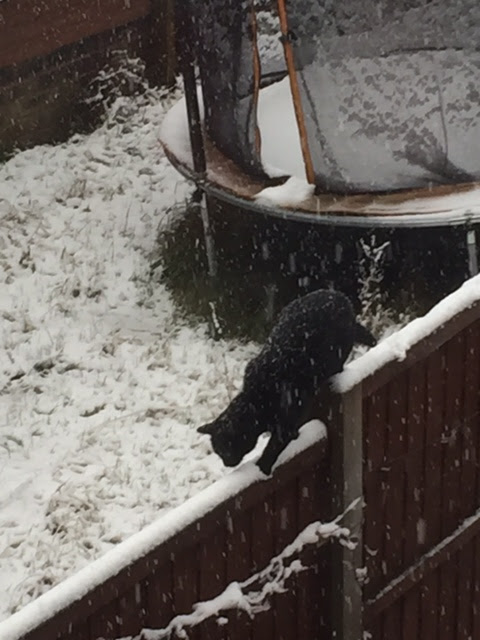
We had quite a few hours of snow today, which has settled (or stuck, as they say up here). I don't know what other areas have had it - my colleague in rural Derbyshire at about 9:30 hadn't - which is the opposite way round to usual. By the time it stopped it was a good couple of inches deep, possibly more. It was nice, looking at it and knowing that I didn't have to set foot outside the door. I haven't even unlocked the back door for two days (and the front door, of course, is never unlocked - this is Walkley).

I wonder if it will still be there in the morning.


Wednesday, 13 January 2021

Aeon

 A few weeks ago, Firefox pointed me to this article by Joanne Limburg. It's about - among other things - the experience of being (female, late-diagnosed) autistic. I'd already read some of Limburg's work - her first memoir, on living with OCD, The Woman Who Thought Too Much, and her book of poems, The Autistic Alice, although I didn't make the connection when I first read the article. Limburg is a writer, and works in a university - and this is important, because so much of what is written about, and for, and even by, autistic people, about us and the world of work, ignores the professional workplace; as if, perhaps (and maybe this is true) we had fewer problems than someone being coached to stack supermarket shelves.

The article said so much that I have wanted to say to people at work. I can write, but not as well as Limburg, and also - sadly - people are more likely to take something seriously if it is written and published by a third party, rather than sobbed at them in frustration by their slightly odd colleague who 'makes them feel uncomfortable.' So I shared it with t'Boss, who agreed, and soon I shall share it with my other colleagues. But that isn't really the point of this post.

The article was in an online magazine which I hadn't previously come across, called Aeon. Firefox Pocket clearly did a good job in bringing it to my attention. Unusually, for me, I signed up for their daily email of articles, and find I have had something to read over breakfast every day - ranging from what neanderthal women did, through flirting and courtship in the eighteenth century, to scientific discoveries and political theory - written and edited by academics and experts, free and with no ads. So yes, I recommend it.

Tuesday, 12 January 2021

Today

According to my colleague Simon, today is National Soundcheck Day.

I think this was last held eight years and a month ago. 

Monday, 11 January 2021

Sunday, 10 January 2021

Hellebores


The Lenten rose is somewhat early this year.


Saturday, 9 January 2021

Squirle

Many years ago, in my first or second year of teaching, at Sussex, I had a student who was French (those were the days). One day he was late for a seminar, and and the gist of his apology was:

''Zere was a squirle in my room. I say to 'im, Meester Squirle, you must leave now. But 'e 'ide under ze bed'

Thus for the past twenty years, members of the species Sciurus carolinensis have been known as squirles. At Sussex they were very tame, and would take nuts from your hand.

As a child - I have no idea what age, about thirteen or so - I 'rescued' or otherwise acquired a young squirle, and kept it in my room for a bit before releasing it back into the trees at the bottom of the garden. This is how I know that squirles have fleas the potency and malignancy of which puts those of cats and dogs in the shade. And we also had about nine cats at this time, so I know whereof I speak. Come to think of it, I think that was how Che (for that was the squirle's very temporary and slightly onomatopoeic name) came to be in the house and needing rescuing in the first place.

About this time last year I hung a bird feeder on the clematis wire outside the dining room window, with fat balls in it. No birds ever visited. The fat balls went rancid and mouldy. I was, therefore, very surprised before Christmas to find scatterings of fat and husks on the ground beneath it, and the contents gone. I replaces them, with fat balls that were not mouldy, but probably every bit as rancid, and, as I had half expected, my customer was not a bird, but a squirle. The photo shows it having retired to the fence to finish some particularly tasty seed. The new balls were gone within a day - but an awful mess left on the ground. So I put some nuts out on the wondow sill instead - but somehow the squirle hasn't worked that out yet.

Friday, 8 January 2021

Berlin Wall

As I mentioned in yesterday's post, I have a number of pieces of the Berlin Wall. My sister was in Berlin in early 1990 - in pursuit of David Bowie, which I suppose makes this an appropriate post for the fifth anniversary of his death. Pursuit of David Bowie was where she was most of the places she was, other than Newport, Gwent. She brought us each back a piece. Mine, I subsequently discovered, was the smallest, and fell apart. 

However, I now also have in my possession her piece:

The piece she gave our mother (the biggest and the best piece):
And, as I finally unearthed over Christmas, our father's piece:
You may be wondering why the first two are so beautifully photographed - at least, I hung a velvet jacket from the fence and photographed them against it in daylight in the garden back in the summer.

The reason is that I wanted to feature them in a short 'mystery object' video which I'd agreed to make to use in online outreach. There were going to be others, but somehow mine was the only one to get made. You can watch it here. Although I fear some people might be terribly disillusioned by finally hearing the sound of my voice.

Thursday, 7 January 2021

1970s glassware

My father died in 1992. My sister and I packed up the contents of his flat. Some boxes went back to my place, some back to hers. When my sister died, her boxes ended up in my mother's spare room. When my mother died nearly five years ago, they all found their way back to me.

Over Christmas, I opened the last one, and picked through the crumpled 1992 newspaper. This was a box that my sister had packed, of ornaments from my father's living room. Some I remembered, and some I had never seen before. Most of them, to be honest, were not very interesting - cheap holiday souvenirs. But there was the lovely hand-carved wooden bowl that I posted at the end of last year. There was another piece of Berlin Wall - packed away only two years after being hacked out (I now have four pieces of Berlin Wall, all purchased on the spot from the pickaxe entrepreneurs by my sister in early 1990).

And there was this.

I have confidently billed it '1970s glassware' because what other era could it possibly be from? The glasses are tiny, scarcely bigger than egg cups, from which you can divine the size of the decanter. The stripes are orange. They are probably very trendy in some circles. I must quite like them, because I've washed and polished off the thirty year-old Woodbine smoke and put them out on the dining room sideboard. For now.

Wednesday, 6 January 2021

Twelfth Night

There's always something slightly sad about taking the Christmas decorations down, and letting the chill January light back in.

Happily, I have avoided that this year, by the simple expedient of not putting any up in the first place.

Mostly, I just have a tree. A massive one. Last year, sawing up the Christmas tree, hiding the biggest logs at the top of the garden, and sneaking the rest into the dustbin over the course of months, was the first job in tackled in ... mid-March. This year I was planning to arrange for someone to come and take it away.

Then the rubber plant put on another growth spurt, and, now at over six foot, needed to sit on the floor. The only floorspace was the place where the Christmas tree usually goes.

So I put some fairy lights on the rubber plant instead (thank goodness for heatless LEDs). And it looks so nice (and the plant doesn't seem to mind) that I am going to leave them there.

I did get my advent calendar out again.

Every year I say I won't, because it's over fifty years old, and notwithstanding a brilliant repair job a few years ago by Sebastian's friend's mum who is a book restorer, it is delicate. I have even put a note on its envelope this year advising myself not to use it next year, but I shall probably ignore it when the time comes.


Tuesday, 5 January 2021

Bread

I've been baking my own bread since March.

When I first got a breadmaker, all the advice was that you had to follow the recipe they gave you with scrupulous accuracy, down to the last gramme (and a large wholemeal loaf called for 528g of flour). The recipes that came with it also called for strangely large amounts of sugar, and quantities of dried milk, and crushed up vitamin C tablets. In short, they were replicating commercially made bread - the very thing I wanted to get away from. 

I never added vitamin C, or dried milk, so they have their escape clause if ever I'd tried to complain. Sticking to the quantities otherwise, I could turn out a most impressive white loaf, no problem, but wholemeal always sank alarmingly, giving a slice with a profile like a cat's head, with points that could lacerate you.

Naturally, I sought the advice of the internet, and the suggestion that caught my attention was something along the lines that the machine doesn't get the gluten lined up properly before it starts cooking. I followed their suggestion to allow the breadmaker the sticky job of the initial mixing of the dough, and its first proving, but then turn it out, knock if back by hand, and leave it to rise in a loaf tin before baking in the oven. And this works.

There is the added advantage that your loaf is now a sensible shape and size that will fit into a plastic bag, and doesn't have a bloody great hole in the bottom.

After months of experimenting I have now also arrived at a simple back to basics recipe which, using this method, works every bit as well. And it is: half a pint of warm water (or a bit more depending on the flour); half a pound each of white and wholemeal flour; a level 5ml teaspoon each of sugar, salt and quick yeast, and a glug of oil. I pour the oil over the mixing blade (though I doubt if it makes any difference), then the water, salt, sugar, flour on the top and yeast on top of that - then the machine does all the sticky hard work leaving me with the fun part of the final knead. It goes into a 2lb tin and once risen, into the oven at a touch under 200 C for 35 minutes. It might not always come out perfect, but it's never less than adequate and better by far than the machine baked version.

Monday, 4 January 2021

Cucumber


Well, doesn't it look like Tony Blair?

Sunday, 3 January 2021

Hagstones

When I was a child, finding a pebble on the beach with a hole right through it was a very rare and special event. I didn't know then that hagstones, or witch stones, or adder stones - or one of many other names - were believed to have magical powers. Just finding one was exciting enough.

For years I idly puzzled over what could bore a hole through the hardest stone - for hagstones are usually flint, renowned and used over millennia for its hardness. And that, it turns out, is the secret. The hole in a hagstone has its origin in the stone's formation over millions of years. Flint is formed in chalk, as silica gradually - grain by grain, molecule by molecule - replaces the calcium carbonate through a chemical reaction. This is why flint is most common along the chalky south coast. As the chalk wears or is washed away, the flints are released, and in many cases fall into the sea to be worn and smoothed into pebbles. In some flints, before they became flint, there would have been a fossil, or something other than chalk, which instead of turning into flint would form a softer stone. While the action of the sea would only very slowly rub the corners off the hard flint, this softer stone would eventually be worn and washed away, leaving the hole.

All the time I lived in Newhaven, we rarely visited the stoney beach, preferring instead the enclosed and sandy West Beach until it was preremptorily closed. But going back now, and walking the dogs at Tidemills and on the beach to the east (which has sand at low tide) we encounter a lot of pebbles. South coast, flinty, pebbles.

And, once you get your eye in, hagstones aren't that rare. I now aim to find at least one on each visit.

As a result, I now have forty-five. I put them out in the garden last summer, in the old stone sink, but this morning I brought them in, gave them a rinse, and laid them out on the washstand in the dining room. 

This was partly in recognition that they are - notwithstanding their relative abundance in Newhaven - rather special, and also to bring a little bit of seaside into the house deep in an inland winter.

I might also have knotted them onto a cord in various ways to hang outside the door, to keep away witches and evil spirits. Or I could protect the house by attaching a hagstone to my keyring (although I find a bottle opener more useful). I could hang one around my neck to fend off impish tricks. Perhaps my bathroom is particularly protected, as I have long had a hagstone as the pull on the end of the light switch cord.

In a couple of my stones, a little bit of shingle has got wedged immoveably within the hole.

Now they are indoors, I can get to know them better. We may not believe in their magic as such, but they are a constant source of wonder, and have the power to transport me back to the seaside, which is magic enough.


Sources of information:
https://puffinsandpies.com/2019/08/01/hagstones/
https://www.geolsoc.org.uk/Education-and-Careers/Ask-a-Geologist/Earth-Materials/Flint-Formed-in-Chalk

Saturday, 2 January 2021

Moth

I posted about my old furry (and otherwise textile) friends two years ago.  Eventually I brought them home in a cardboard box and stowed them - safely, so I thought - in the attic.

But when I went to look one of them out before Christmas, tragedy had struck the merry band, in the form of a vicious attack by moths.

In the case of Daisy and Bonny, this proved fatal. Some of the others also, to whom I wasn't particularly attached, have been banished as likely carriers.

On the plus side though, as a child (literally) of the sixties, most of my toys were made of synthetic fibres. So Jumbo Tint is unscathed apart from a tiny nibble to his velvet ear-lining, Mint the dog is no more dog-eared than previously, and Whisky the Crimplene rabbit remains pretty much indestructable as long as he stays away from hot irons.

They have all been quarantined in a big plastic bag pending treatment.

Today's reason to be cheerful: Finally getting a supermarket delivery slot for the first time since October.

Friday, 1 January 2021

Tickets

When I return from a train journey, I put any remaining tickets in a Measham jug on the mantelpiece.

Coming back as I do to Sheffield, where there is a right of way through the station, and hence no barriers, I nearly always have my return portion at least.

Yesterday evening, I took them out and sorted through them. I put them into date order, and laid out one for each journey.  


2019


2020


Thursday, 31 December 2020

Rudolph in the Rivelin


On impulse last Sunday I got up and went for a walk. The sun was shining, and it was bright and mild as I set off for the Rivelin Valley Trail. What I had reckoned without was the fact that it was Sunday, sunny, bright and mild, meaning thet tha trail was the busiest I've ever seen it (not hard, as I usually go first thing in the morning).

It was the most people I've seen for months and probably for over a year and while I wasn't exceptionally worried - out in the open as we were - about their potential germs, it was all a bit overwhelming. So I decided to complete the trail and go back by road, making a circuit (as it turned out) of 8.6 miles - not bad going considering how out of condition I am.

I started in Malin Bridge, at the confluence of the rivers Loxley and Rivelin,

which is about a mile and a third from home, and emerged on Manchester Road on the southwestern outskirts of Sheffield, the trail itself being about three and a half miles long.

Along the way, a number of trees and holly bushes had been hung with baubles, and a Rudolph had found his way into the middle of the river. There was a lot of water and I took the long way round rather than risk - or even try to locate - the stepping stomes of my usual route.

Everyone on the trail was very cheerful and friendly, and no one was ostentatiously keeping their distance. On the way back by road, however, people's behaviour was very different. And I wondered at the risk assessment process that led people to the conclusion that briefly passing within six feet of another pedestrian in the open air was more dangerous than walking into the A57.


Wednesday, 30 December 2020

Woke up to this and thought 'oh bugger'

Then I remembered that I don't have to go out.

I don't need to negotiate slippery slopes and shuffle through slushy gutters.

On current plans, I won't be expected to leave the house until February 10th - and that's if face to face teaching still happens. Thanks to Jim, I am restocked with chorizo and parmesan; my cupboard still has adequate supplies of Brexit beans, and the wonderful Beanies will supply my fresh veg, provisions and healthy wholemeal needs (although I am bracing for lots of post-Brexit native British roots).

Yes, it's cold and dark outside, but the worst thing about the cold and dark is having to go out in it. Those of us who have central heating and electric light are spared the worst of that, and I for one am very grateful.


Tuesday, 29 December 2020

East, West ...

 
This hand-carved wooden bowl, which I brought back from Sussex, was a present to my father from a German friend. More, perhaps, of my father's time in post-War Germany another time.

For now it's a way of distracting you from this post being a shameless ripoff of one (one more, probably) of Diamond Geezer's; to whit, the furthest North, South, East and West that one travelled in 2020. 

The furthest North I travelled was on January 27th, and was quite a decent distance:

This East coast city also marked my most Westerly destination of 2020.

I visited my most Easterly point almost a year later:

Which was also, by a small margin, the furthest South I ventured in 2020.
So that is either quite unadventurous, or commendably economical - two for the price of one, twice.

Most of the year, of course, I spent pretty much in the middle of the map.


Monday, 28 December 2020

A new beetroot for the collection

 
When I last (I think) wrote about my anthropomorphised pottery emotional vegetable receptacle collection, it numbered three (two sad onions and a confused celery). It has since expanded to fifteen - a true collection indeed, including six onions (mostly sad), three celeries, three beetroot, a chutney, an apple sauce, and a cucumber that looks like Tony Blair. Seven of these were purchased as a complete collection, in a charity shop in Hassocks, when I was visiting a friend there. This was quite soon after the collection was begun, so was very serendipitous (and I am clearly, therefore, not the only one). The remainder I have picked up singly in charity shops (and I think I had one further onion from Sebastian).

The most recent acquisition is an absolutely stunning SylvaC beetroot which Sebastian gave me for Christmas. I have had to promise him that I will leave the collection to someone else in my will.

Sunday, 27 December 2020

Accounting for reading and writing

Yesterday's post, was - finally - the 1500th on the Chertsey blog.  On some measures, 1500 in eleven years isn't bad. On the other hand, I managed 859 in just four years on my previous blog (actually, three and three quarters, as I didn't start blogging until April 2006). And if I had posted every day (like some I could mention), then the total would be over 4000.

But 1500 out of a possible 4019 is still pretty good, I think. It's an average of 136 a year, or just over two and a half a week (or one about every two and a half days). No, not bad at all.

But this post is actually about the books I read in 2020 - or, rather more accurately, since March 2020, because I wasn't really keeping a record before then. I haven't actually kept a record since, so this is compiled from looking at my shelves and scrolling through my Kindle. Given that the last lot of library books, due back according to the ticket on March 23rd, are still in a pile on my attic landing, I think this must account for everything, and if inaccurate, will be an underestimate.

This is books read for fun - not articles, and not stuff read for work. If I tried to count the thousands of words I've read I wouldn't know where to start.

I make the total of books read for fun in the latter nine months of 2020 107. This is actually less than I thought it would be, as a couple of novels a week is pretty much part for the course. But, given that I don't go out much anyway, there isn't really any reason to expect I would have read more this year, and maybe a couple of reasons I might have consumed less - work being extra busy, for one, and the sheer amount of snooker on the telly for two. 

Notably, I have consumed a number of complete series in chronological order, including:

  • Harry Bingham (Fiona Griffiths) x6 (still waiting for the next one)
  • Ellie Griffiths (Ruth Galloway) x 12
  • Christopher Fowler (Bryant and May) x 17
  • Stuart MacBride (McRae and/or Steel) x 15 
  • Ian Rankin (Rebus) x 23
  • Andrew Taylor (Lydmouth) x6

plus five volumes of biography/memoir, and roughly 22 other novels on the Kindle, mostly entirely forgettable.

Aside from the series, most of which were rereads (but so much better in the right order, except for the Rebuses, because the early ones are terrible), some of my most memorable reads of 2020 have been Ray Monk's mammoth two-volume biography of Bertrand Russell (which probably dragged the average down a fair bit), Louise Doughty's Platform Seven, which for a ghost story was actually strangely haunting, and Lucy Atkins' Magpie Lane. Oh yes, and I also bought and read Ian Dunt's How to be a Liberal, which I have many criticisms of, but tempered by the knowledge that it wasn't aimed at scholars of liberal political theory (shamelessly altering quotes, though, I think is beyond the pale for anyone). 

Saturday, 26 December 2020

Good morning Sheffield

I've just spent a few days in Tier 2 Newhaven (taking my Sheffield Tier 3 rules with me of course) and curtailing my visit to escape before Tier 4 extended its reach across all of East Sussex (keeping to both the letter and the spirit, which often require completely different actions, requires quite a lot of effort and creative thinking, but given that I scarcely leave the house the rest of the time I have it to spare). 

This meant driving back on Christmas day, reminding me that the last time we drove any significant distance on Christmas day was fifteen years ago, when we first had Warrior, and spent a very cold Christmas enjoying the delights of Chester.

Newhaven was storm-tossed and flood-washed for most of the time I was there, but Christmas day dawned clear, bright, dry and suddenly very cold. The roads were not icy though and the run back was excellent. Expecting a long spell of cold weather, I was pleasantly surprised to find Sheffield balmy this morning.


And a beautiful sunrise to boot.

Saturday, 19 December 2020

Excuses

 Reasons I haven't posted since October:

  1. Semester 1 - remember, Semester 1 is always like this
  2. I haven't done anything
  3. I haven't been anywhere 
  4. Semester 1 cubed
  5. Avoiding the internet
  6. There's been lots of snooker on
  7. Screen fatigue 
  8. General laziness
  9. Bah. New Blogger interface.
  10. Really, what is there to say?

But now I have posted this post, 2020 will not quite equal 2015 as my all-time least-posted year. Hooray.

So don't go away. Iwill be back ... occasionally.


Monday, 12 October 2020

Rules (and tiers before bedtime)

 Autistic people love rules, right?

It certainly felt like it when I was explaining last week how the Programme Regulations for East Asian Studies didn't permit an optional languages module in the foundation year. Nope; those are the regulations. Yes, I know it's not logical; I know it's not consistent, but that's what was agreed with the department and THOSE ARE THE REGULATIONS. You can try and change them if you like; you can apply for a Special Regulation, but as it stands your student can't do that language module.

At this stage of the academic year, I'm doing a lot of work on getting students to do academic referencing. Not teaching them how to do it perfectly. Yet. Just to understand the principles behind it and not be scared of it. I love referencing. I am a Harvard demon. I used to be very picky with students' referencing - if I can do it perfectly, why can't they? And then I remembered. When I first started as an undergraduate, referencing made me very uncomfortable. Rules. That I didn't understand. And that I might get wrong

I came to understand them, and I grew to love them, with a passion. Just as I do Programme Regulations. Known, understood and unchanging rules are a secure framework; a comfort blanket, something to fall back on when all around is chaos.

But I think, perhaps, that like being supremely well-organised, loving rules may not be an inherent autistic trait. It might be a coping strategy. One that has become so ingrained we lose sight of the fact that it's not our natural default. We gain mastery of the rules because the alternative - the prospect of getting it wrong - is so unbearable. To avoid this, we may even rebel against the rules and refuse to play the game entirely.

When I wrote this post, back in March, I though of myself as a person who didn't like obeying rules (and indeed, obedience - the loss of autonomy - is a bit of an issue). But that same person didn't leave the house for four months in order to avoid being confronted by those rules. Scared to obey; scared not to, and above all, scared of not understanding - the only option then is to avoid them completely.

I love rules.

Rules frighten me.

Unclear rules make me uneasy.

Unclear rules enforceable by the power of the state terrify me.

Irrational rules cause me significant internal conflict.

Unclear and irrational rules enforceable by the power of the state are the reason I don't go out.


Monday, 28 September 2020

Mad world (or, a collective action problem)

 Oops, it's been a while. I thought I'd better not let September go by postless, but what is there for an extremely busy recluse to write about?

Yup, the world is officially, outrageously, barnstormingly bonkers, and if the press is to be believed my beloved profession is at the heart of it. And I have to say there's some truth in that. On Thursday, if I can muster the courage (I have someone standing by to step in if not), I shall be back in the classroom. From having not been near more than one person at a time for six months (and that rarely) I shall be faced with fifteen of them, from all over the country. Then after an hour, another fifteen. Then after lunch, another fifteen. And then another. They will be sat a metre and a half apart and all wearing masks. We can't have any handouts or groupwork. They will get 45 minutes of this and that will be their lot of what we somewhat ironically call 'face to face' teaching for the week.

I have been fearsomely busy these last few weeks turning most of my teaching into online teaching. This has been really exciting and I - along with my colleagues - are doing some really good, engaging, imaginative and innovative stuff. My students will be getting better value this year than ever before, in terms of the thought and structure that we are putting into their learning and the amount of material we are pulling together for them. Online tutorials will be far smaller than conventional classes and each student will get more individual attention. The library is forking out a fortune for new ebook licences so that everyone will be able to access the books I set, rather than wait for someone to bring a copy back to the library. As at the end of the last academic year, the university is making funds available so that everybody has the IT hardware and online connection they need. So do not for a moment believe that online teaching is a cheap option, or that it is not good value. Do not think, either, that it is not good teaching. It is.

That is not, however, to say that students will have as good a learning experience (as the jargon has it). Of course they won't. You cannot reproduce online the buzz of a heated seminar debate, or convey the enthusiasm of a tutor leaping up and down and waving their arms around in front of the class; above all you can't create those tiny unexpected conversations which can open up whole new worlds. It won't be such fun. But we can still prepare our students to start a successful degree programme next year; the foundation year can and will still deliver on its promise. And - as I consoled one student last week - with any luck they get a second chance at the whole freshers' week thing when they start their 'first' year next year. 

But to get back to my earlier point - what I was trying to convey there was that while in many ways online teaching is no substitute for 'normal' face to face, it's probably a lot better than Covid face to face, with all its inevitable limitations. And that's just looking at it from a teaching point of view, without considering the other risks.

So why are we going to such massive lengths to deliver, at some non-trivial risk to students and staff, what is likely (although I must, I know, reserve judgement until after I have seen it) to be a less good learning experience?

The answer is that this is what we doctors* call a collective action problem. It's an absolute classic of the genre.

Back in the spring, students, applicants and potential applicants, when asked, said that they would like face to face teaching when they went to university in the autumn. Back then, we all had the generally vague sense that by now things would be more or less back to normal, if you recall, rather than heading lemming-like for the cliff edge. So why wouldn't they say that?

Many people counselled that it would be sensible to plan for entirely online delivery this autumn, to forestall the biggest internal migration in the UK. Many universities probably wanted to. But there was also a widespread fear that recruitment would drop very sharply across the board, increasing the pressure on each university to attract applicants, and that universities whose student numbers fell would have to close courses and lay of teaching staff - a position that they might never recover from even once student numbers (almost inevitably) picked up again. No one wanted to be that university. 

If some universities were offering face to face, and some online only, given what applicants had told pollsters, it was reasonable to assume that any institution that went online only while others were still offering face to face would be signing its own death warrant. 

Even if all universities wanted to go online only, no-one would dare to. That's the essence of a collective action problem. It's in everybody's interests to do X, but only as long as everybody does it.

But if everybody else does X then it's in any individual's interest not to. If everyone else is going online, then the institution that offers face to face is going to hoover up all the applicants. The usual way of addressing this problem is either for all the parties to come to a binding agreement - with some mechanism in place to ensure that they stick to it - or for it to be imposed by a greater power. 

Universities UK could have done the former; the government could have done the latter. The majority of universities would probably have been mightily relieved to have a level playing field on which to compete on the quality of their online offer. We could have avoided this entire mass migration of students, significant numbers of whom are already doing their courses entirely online but in what is effectively a cell miles away from their families and support networks.

And now, even now that the madness of the situation is staring us in the face and students aren't nearly so gung ho for their face to face experience, we can't back out of it, because the government has effectively told students that they can sue universities under consumer protection legislation if the universities don't deliver what was promised. We promised 'some' face to face teaching, and 'some' is what they're getting - and we're telling them that they have to turn up to it unless they've a good reason not to.

One of my favourite WonkHE bloggers has summarised it in a far more measured way here.

So yes, it is all mad, and yes, it could have been completely avoided, but no, it's not a conspiracy by exploitative money-grabbing universities. It's a collective action problem.


*of Philosophy

Saturday, 8 August 2020

Down to the river

That should be 'up and down' really. I could just go down to a river, to the Don, but that's not a very picturesque route, nor indeed bit of the river. But I have now found a route to the Rivelin which is not as hilly as my previous one, and is only just over a mile and a quarter, so I aim to make this a regular walk. 

When I first set out on Wednesday, it was pretty much the first time I'd left home in four months, total avoidance being my coping strategy of choice. And I wasn't missing people, or shops, or indeed nature, or the great outdoors (as opposed to the small outdoors of my garden), but I really, really felt that I needed the exercise, and that's what drove me out, early in the morning before anyone else was around.

It's impossible to imagine now, but the lower Rivelin Valley was - in terms of the use of water power -  once one of the most heavily industrialised stretches of river in the country, with twenty watermills in a three mile length, the first built in 1581, and the last still operating in the 1950s.

This is (if I have identified it correctly) the remains of the overflow weir at Mousehole Forge, which was still making anvils in the 1930s. The waterwheel was used to drive air into the forge.

Friday, 7 August 2020

And the answer is ...

 ... they were both born in the Black Country.

I said it was surprising.

Thursday, 6 August 2020

Evaluating commentating

I wonder whether the BBC has any means of seeking viewers' feedback on snooker commentators - a bit like students give us feedback at the end of each module. Because if they do, how come they still employ John Virgo? Now, a small mercy of the current situation is that John Virgo is stuck in Spain, and is thus unable to make me scream and throw things at the telly, for the first time in living memory.  However, the BBC are trying out a few new names, and there is some close competition for the role.

The maddening thing about Virgo is that he burbles. He thinks we want to be party to his every fleeting thought, and that any silence in the commentary box is there to be filled, preferably by him. I don't know about you, but what I want to hear from a commentator is their considered opinion or insight, not the entire process of arriving at it. Twice. And then burbling inconsequentially away from it afterwards.

Sadly, the BBC seem to have found a worthy successor in this regard in the shape of Joe Perry. Now, I've always liked 'Gentleman Joe' as a person, even if he's never excited me as a player. But my god I wish he would shut up, rather than sharing every thought as he thinks it, with, it has to be said, the added annoyance of a rather irritating intonation. There is, perhaps, some hope for Joe though; he's new to commentary and perhaps it's nerves. Perhaps he could learn to say a little less and make it count a bit more.

Because it is good to have players in the commentary box, even if they're not the greatest commentators. There are two new voices on the BBC this time who aren't players or former players: Dave Farrar (who he indeed) and MC Rob Walker himself. I had never heard of Dave Farrar, but Google tells me he's a football commentator. I find that quite hard to imagine. As a snooker commentator, however, he seems made for the role, in the mould of 'Whispering' Ted Lowe. He's a good commentator who knows when to keep quiet and asks pertinent questions about play of his accompanying pundit, although he's not one to go to great leangths to avoid a cliche.

After seeing Rob Walker doing his MC thing live in 2016, I decided that he wasn't as annoying as he appeared on the TV. I have now reconsidered that and reverted to my former view. He's a decent MC and a good interviewer, but please BBC do not put him back in the commentary box again. Not only does he not shut up, but unlike Joe 'thought process' Perry, he's not even talking about the game he's meant to be commentating on, but telling lengthy anecdotes and not even noticing when something interesting happens on the table.

As for the remaining player/commentators, how would I rank them?

Denis Taylor is annoying; he talks too much, but not to such an extent. Get him and Steve Davis or John Parrott in together and it becomes a bit too pally, a little bit cliquey. Steve Davis - who was my favourite player for decades - is OK, and so is John Parrott when he's not in with one of his mates. I used to like Ken Doherty, but either he's lost his touch, or I've just heard it all before. If he ever opens his commentary with any line but 'I couldn't agree more Denis/John/Steve' it's a shock, and also why do players (and Doherty is not the only offender here) never simply have great cue power; why must they always be blessed with it? Also, there's something slightly sinister about him. While all other snooker players look about 20 years older than their actual age, Ken Docherty looks 20 years younger and is still going backwards.

So who does that leave? My runner up is Alan McManus, mainly because I just love listening to that voice. He's also knowledgeable and genuinely enthusiastic, but without quite talking too much, mostly. There was a phase where he was always predicting the players' next shots wrongly, which was quite amusing, but he seems not to do that so much lately.  But - slightly surprisingly to me - my top commentator is Stephen Hendry. Very knowledgeable, good at explaining things, and rarely opens his mouth unless he has something interesting to say.  I was also impressed over on ITV4 with the commentating debut of Peter Lines - I thought he was particularly good at explaining what players were doing, and why - perhaps the BBC should snap him up.

Finally a mention for the BBC's new presenter, Radzi Chinyanganya, the Sabbatical Officer for snooker. Or as a fellow snooker fan academic put it, he looks like a media studies student on work experience. He's actually an economics graduate from Loughborough and - who knew - a former Blue Peter presenter. Maybe I'm getting old, but his breathless enthusiasm still smacks to me of children's TV.  But here's an obscure quiz question for you, with a very tangential boating link - what surprising thing do he and Ronnie O'Sullivan have in common? And because not even my even-more-snooker-mad-than-me-friend didn't get it, here's a clue: you wouldn't know it from the way they talk.


Wednesday, 5 August 2020

Interesting figures

Average age of the male referees at the snooker World Championship: 49*

Average age of the female referees at the snooker World Championship: 31

We must just be quick learners.

Of course Tatiana and Desi will still be refereeing in their fifties and sixties.


*Five out of seven male referees for whom I could find birthdates. Including 31 year-old Marcel Eckhardt pulling the average down. In all cases I have assumed that they have had their birthday this year.

Do you have a favourite snooker referee? Mine's Paul Collier.

Tuesday, 4 August 2020

The mysterious world of the External Examiner

I thought you might be wondering what I was doing in Edinburgh, at the end of January, making tea with two hotel teabags (they only supplied four; I had to go out and but some more, plus empire biscuits - a delicacy of which I had been previously unaware - for my expatriate Scots colleague).

I was there to undertake that mysterious activity known in academic circles as 'externalling'.

Universities are all technically independent, autonomous institutions, setting their own standards and overseeing their own degree programmes. There's no National Curriculum; no SATs, and no common exams like GCSEs and A Levels. Yet somehow, students and employers need to know that a first class degree from one university is in some important way equivalent to a first class degree from another - possibly very different - institution. (And yes, I know that on one level that is a forlorn hope, because  universities and some degree programmes are so very diverse, but bear with me for now).

Students also need to know that their work has been set and marked fairly, and to standards roughly the same as for students at other universities, and that it's at the same level of difficulty; they want to know that their degree classifications have been worked out correctly, and that all the marking has ben transparent and above board.

The traditional - and indeed thriving - means of achieving all this is through the offices of the External Examiner. An External Examiner ('External' for short, usually honoured with an initial capital) is an academic, in the same field, from another university. Rather than one body overseeing every institution, there is a vast criss-crossing network of Externals who between them, theoretically at least, ensure standards and consistency across the whole sector. 

So every now and then, a request gets circulated (often in our case via the Foundation Year Network) for an External Examiner for this or that subject area - Externals' terms of office generally last three years, and there are rules about not having reciprocal arrangements, or more than one external from any one institution in a department, or anyone holding more than two externalling posts. When we see a call in our subject area, naturally our first thought is 'How can I fulfil this opportunity to serve the academic community?' and not 'Will this look good on my CV?' or 'Will it be a nice place to visit?' I must confess that I have been known to apply the last criterion, hence my current External Examiner posts being at York and Edinburgh.

The other thing you don't ask is 'How much are they paying?'  They are paying, but it's probably not much. It's one of those things academics are expected to - and willingly - do from a combination of status-seeking and good citizenship. We know that the system depends on us all playing our part. There is also of course the opportunity to spend five hours on a train and a night in a hotel with four one-cup teabags at someone else's expense (which as unalluring as it sounds is a damn sight better than trying to do it via Microsoft Teams).

It is quite a lot of work though. For every Exam Board you attend (and Edinburgh has lots, which disappointingly at the moment means lots of Microsoft Teams and not so many opportunities for that long awaited Big Day Out to Ladybank) you have to look through samples of the students' work (which now includes videos), and the marking and moderation, and feedback, and the processes by which marks have been arrived at, and extenuating circumstances determined; you need to be familiar with the particular institution's unique set of arcane regulations (Null sit? Ah, that's what we call NA ...) and (the worst bit, for me) look at spreadsheets. The horror. Then you have to write a report.  On the plus side, you get to meet lovely people doing the same job as you in different places and have a good natter/moan/gossip share best practice.

The real compensation, though, is that as an External Examiner, you are treated like a god. Or at least minor royalty. You are, for some reason I have yet to fathom, an Important Person. Probably because you report direct to the university above the level of the department. Therefore everyone is very nice to you and nothing is too much trouble.
See? Plied with regional delicacies. And terrible tea.

Time was, you got a slap up meal too, though none of my posts has ever offered that and in these days of financial belt-tightening I fear that tradition may be gone for good. So I had to fend for myself in Edinburgh:
It was not the most joyous repast of which I have ever partaken.

At Sheffield we used to have a generous, but stringently regulated budget for entertaining Externals. The rules were that you could buy a meal for one member of staff for each External present. Back in the days when there were a number of us each running our own degree programme, a colleague would annually take her External out for a proper posh dinner. One member of staff; one External - the University happily stumped up eighty quid. I on the other hand took my External and my Programme Administrator who did all the work of preparing for the board, to lunch in the local Wetherspoons (this was when Brexit was still a gleam in Nigel Farage's eye) where - being incorrigably abstemious - we managed to spend fifteen quid in total. I sent the receipt in to the External Examiners office, and received an admonitory email and reimbursement of ten pounds, because they wouldn't pay for the supernumary person.

Monday, 3 August 2020

Alternative holiday

I decided back in mid June not to pursue the Croxley run after all this year - for a number of reasons, most of them 'what ifs', but the overarching one being to get rid of the what ifs and give myself some certainty. We already knew it would be nothing like we had planned, and my key co-planner wasn't able to come after all, so we're aiming for next year.

What to do, then, with all that leave I wouldn't use?

Bring it forward a couple of weeks for a perfect Sheffield - nay,  sofa - staycation.

Never, in my forty-plus years of following the World Championship have I been in a position to watch - should I wish - every single match. And knowing that it's actually happening just a mile and a half down the road does make it a bit extra-special.


Saturday, 1 August 2020

How I'm marking Yorkshire Day

Well, how else?
Should keep me going for another three and a half months.

Friday, 31 July 2020

Stretch

My rubber plant reached the ceiling today.

If it had reached the ceiling yesterday, I might have made it into Diamond Geezer's list of current blogs who have him in their blogroll.

As it is, I'll have to settle for 'almost current'

Oh, and it is touching the ceiling, honest. It's just a rather pale tip.