CHERTSEY

BOATS, BRIDGES, BOILERS ... IF IT'S GOT RIVETS, I'M RIVETTED
... feminist, atheist, autistic academic and historic narrowboater ...
Likes snooker, beer, tea, rivets and solitude, and is strangely fascinated by the cinema organ.
And there might be something about railways.
**********************************************************************************

Thursday, 4 April 2019

Down the river to Rotherham

Every previous time, when I've got to the bottom of the Sheffield Canal, I've turned round and come back. But not last Sunday, when instead I turned left across a bridge, and found myself on the towpath of the River Don, heading towards Rotherham. For much of its length, the Sheffield and South Yorkshire Navigation is embanked and canalised, but there are some rivery stretches too.
Here we are looking back toward Sheffield - Sheffield to the right; weir to the left.
And here, that sign in the distance promises the far off glamour of Doncaster, Goole, Leeds and Keadby.

Along the way we saw a fair few local people enjoying the river. Some were just strolling the wide, well-made paths. Others were fishing, or magnet fishing, and one lot had lit a fire on the bank - they weren't all what everyone would consider the most desirable characters, but they were all minding their own business and didn't cause us any trouble. The only moving boat we saw all day was Ethel, the wide community boat from the Basin, which was taking a small party of children in enormous lifejackets as far as the top lock.
There were swans in this very large winding hole.

And so we approached Rotherham
Rotherham Central station - there on the left - piece of cake to find. Parkgate Tram-Train stop... not so easy.
On this lock, one top and one bottom paddle have to be left open to feed the canal. Paul wondered why some people seemed to have trouble understanding this... But the sign actually says: 'Please ensure headgate and tailgate sluices are left fully open when leaving the lock. Offside sluice [sic] are kept closed and locked by CRT.' It's not exactly helpful, is it.
Below the lock is the remains of a swing bridge.

From Tinsley bottom lock to here was just under two and a half miles - as Paul pointed out, it's easier to keep going to Rotherham and get the tram back than it is to turn and walk back to Sheffield.

Wednesday, 3 April 2019

A local boat for local people

I wouldn't like to swear that this was a Sheffield keel (or Sheffield boat) but it's certainly the nearest thing I've seen on my travels so far. I realised in conversation with David the weekend before last that I know next to nothing about these boats, and now I'm here I really should, so I've started giving myself a crash course, starting with Paget-Tomlinson's British Canal and River Craft (1979).

What I learned first from David, and have since built upon, is that the term 'keel' actually denotes the kind of sailing rig that the boat would have had, rather than actually telling you anything about its hull. They come in various sizes, with the Sheffield size being the most common.

Now this is interesting, because a Sheffield boat is 61'6" x 15'6".

My new 2017 edition of Nicholsons (p. 149) says 'No boat longer than 60'0" may now use these [Tinsley] locks.'

So have the locks suddenly got a foot and a half shorter? Is this why they felt obliged to use a cut down large Northwich instead of a Sheffield boat to lead the bicentenary parade? I was speaking to the lock keeper on Sunday (of which more, perhaps, anon.) Maybe I should have asked him. Or maybe not.

Tuesday, 2 April 2019

Is it a tram? Is it a train? No! It's Supertram Tram-Train!

Paul confessed to me on Sunday that when we were tentatively agreeing to meet and undertake our respective surveys of the Sheffield Canal in tandem, he was unsure how he was going to break it to me that we would have to travel back on the tram train so that he could add it to his railway experience collection, and thus was relieved when I suggested that no day out to Rotherham would be complete without such a trip.

The tram train (or Tram-Train) only started running last October, which represents pretty early adoption for me. It's a tram, that runs - for an admittedly short distance - on a railway track. This means that it has to be a special tram, just that bit tougher than an ordinary tram, and that it has to have special signalling, because it's not nearly as tough as an actual train and thus has to really avoid having a train running into the back of it.  (Paul explained this to me, along with what the signals we saw along the way meant.)

The tram train starts at Rotherham Parkgate, hidden round the back of a shopping centre. The SSYN towpath delivered us with ease to Rotherham Central station, but we had no hesitation in agreeing that we needed to start at the very first/final stop, so spent another half hour or so trying to find it.
There are three tram trains an hour, but not at regular intervals - they have to fit in around the other (real) trains. We arrived with 23 minutes to wait (not an hour and 23 minutes, as it appeared, the next tram/train indicator being on BST but the clock display still showing GMT). It was a pleasant enough and quiet place to wait. Very quiet.
You can tell which are the tram tracks, because round these parts they're the only ones that are electrified.
Eventually we heard the tram train approaching...
I've seen these new models plenty of times in the city centre, but not here doing what they were built to do. So on we got, and nabbed the best seats directly behind the driver's cab (there was at this point, only one other passenger) which gave an excellent view both of the inside of the cab and the controls, and also of the track ahead.
As a fully integrated part of the tram network, a single ticket to nearly all the way home, including a change, was £2.50.
The conductor brought the driver a bar of chocolate (he seemed quite touched by the gesture, and put it aside for later) and then we set off.  It was as well that we'd taken the trouble to start from Parkgate, as we were very soon at Rotherham Central, then soon after that we passed a sign saying 'trams only' then one that said something about line of sight operation (I forget the exact words, but it meant that there were no more signals), and by the time we got to Meadowhall/Tinsley South, we were just on an ordinary tram.

I could have stayed on the tram-train tram until it terminated at Cathedral, but a single ticket doesn't allow you to double back on yourself, so Paul needed to change at Fitzalan Square/Ponds Forge for his connection back to the (Midland) station (well, we kind of started from Victoria...) so I got off there too, and almost immediately, along came a yellow line for Middlewood, so I quickly said farewell to Paul and thanks for his excellent company, and within another five minutes I was making the final climb home after an absolutely splendid day out. I do like the tram.

Monday, 1 April 2019

Walking a Waterway Route

When I last posted about bridge numbering on the Sheffield Canal, Paul from Waterway Routes left a comment, inviting me to get in touch, which I did, and Paul very kindly send me a copy of his SSYN map, which I have to say was splendidly clear and easy to read. More on bridge numbers later, but this post is going to become the third in a series which should probably appear at 5.30 a.m. on Radio 4, called Walking the Sheffield Canal With... Because it quickly transpired that Paul was planning to visit Sheffield very shortly to check on whether any updates are required for the maps he so painstakingly compiles, and we then established that we would both be more than happy to walk from Sheffield Basin to Rotherham and then come back on the tram train, so yesterday that's what we did.

I must confess I hadn't previously paid a great deal of attention to Waterway Routes - I recalled Halfie having given them a trial a while back but it all seemed a bit techie for me. However, Paul has now given me (my first ever freebie in thirteen years of blogging!) a copy, and having re-read Halfie's glowing review of the Memory Map version I'm so keen to give it a go that I may well buy an Android tablet for that purpose (if I understand Paul correctly, it's a lot harder on Apple devices, and it would be good to have a less expensive device (and incidentally one that doesn't actually, technically, belong to work) to take boating). So I will try it and report back, and of course I shall be fearlessly honest, but I must be honest up front and say that Paul is such a nice chap that I really wouldn't feel able to say anything bad about it even if I thought it, which I'm sure I won't - it looked brilliant on Paul's phone. I think the biggest problem I am likely to encounter is installing it, and then finding my way around it - but I'm not a complete IT dunce, as long as I have (a) time to play around, and (b) the motivation of actually wanting to achieve some outcome from it. I have, after all, by those means become (probably) the second most advanced user of Google Drive in the whole department :-)

Sunday, 31 March 2019

Books I read in March

John Le Carre A Delicate Truth (local library)
Took a while to get going, but a disturbing and wrenching story that you know isn't going to end well.

Aline Templeton Dead in the Water (local library)
Not immediately gripping but did grow on me, and towards the end I was being drawn back to it. The police protagonists come across less fully and complexly drawn than the other charachers - but maybe that's because they've developed in other books buit this is the first time I'd met them. I'd read more.

Sam Friedman and Daniel Laurison The Class Ceiling: Why it pays to be privileged
This is for work, but I'm including it here because I read it from cover to cover. Very readable, and interesting. I really must read Bourdieu first hand.

Donna Leon The Waters of Eternal Youth (Kindle, on way back from Saltaire)
Maybe not the greatest Brunetti, but a comforting read.

Stephen Booth Fall Down Dead (local library)
His latest, and marginally better than the last couple, but I prefer writers to wear their local knowledge a little more lightly, and to steer a little more adroitly around vacuous cliche. Also, a bit too much subplot, with clues to the main mystery all thrown in too near the end.

Cath Staincliffe The Silence Between Breaths (local library)
Almost a novella; a miniature. Nicely, economically written. The first third was basically ruined for me though by a massive spoiler in the blurb - so don't read the blurb.

Anne Enright The Forgotten Waltz (local library)
Now this *is* writing - at least at first, so sparse it gives the reader room to breathe, to fill the gaps. I loved the first part of this book; the second, perhaps, is a little more mundane. But maybe that was how it was meant to be; it would certainly be fitting to the plot.

John LeCarre A Most Wanted Man (local library)
Don't know if it's me getting used to him, or just this book, but I found it rather boring - everything played out exactly as expected.

Denise Mina The Long Drop (local library)
Based on a real case, turned into a gripping, shifting human story by an excellent crime writer.

Saturday, 30 March 2019

Time to pick the next Big Day Out

You may recall they my series of Big Days Out started so well, in Saltaire. Er... two years ago. Shortly afterwards, in the pub, I thought it would be a good idea to let my friend tap the screen to pick the next one... and it was Ladybank, so I never quite got round to going, though I did get as far as looking it up and seeing what I could have visited if I had gone. I think there was a golf course.

But anyway, because I didn't do it myself, I have now decided (after two years) that it didn't count, and therefore I do not have to go to Ladybank before I can pick the next one.

So Random.org is all set up, to select a random number between 101 and 186, and I shall now just flick across to the relevant tab and click the button ... and it's ...

111

Oooh ... a boat I know quite well, and a place I've been, although not for a while - and, what's more, where I have a kind of distant quasi-relative, where there should be lots to see, and a canal and a river. It'll take just over three hours to get there, and I must be careful to avoid Gold Cup day.

So you can either guess, or look it up in your Faulkner, or do as I did, and check it out in the Town Class Sticker Album (which really needs updating).

Extra clue - it shares its name with the pub I was in the other night, although the pub has nothing to do with the place.

Friday, 29 March 2019

Mugs game

You know how I like a souvenir mug.

I was particularly on the lookout for a new mug for work. I had a nice work mug. It has written on it 'That sounds like responsibility and I want no part of it', which I thought was quite amusing, but apparently isn't going to help me get promoted.

As I mentioned yesterday, the museum in Swindon had a very large quantity of commemorative 2818 mugs, which the gift shop man was very keen to press on me. Not so keen that it wasn't £5.99, but I bought one anyway, because they didn't have what I really wanted.
So I took my 2818 mug to work and used it for a week or so. It was OK; a bit thick for my liking, but I thought I'd get used to it. But - maybe something to do with the printing process - there was something funny about the glaze on the interior which meant that it stains really badly. I've had tea mugs get stained in London, but never before up here.
And while I've nothing against a bit of good honest tea patination, bear in mind this was never the mug I really wanted.

What I wanted was a replica GWR hotelware one. They had various bits and bobs of it in a glass case at the museum, including a £30 cakestand, but had sold out of £9.99 mugs. So I had a look on ebay, and found the exact same ones, at the exact same price, so I bought one of those to be my new work mug.
With which I am delighted - it has a high quality glaze that doesn't stain at all, and I can proclaim my company loyalty - although the only person likely to care is a colleague from Doncaster who sniffed 'It's not LNER.'

Thursday, 28 March 2019

Oh yes, and there were some locos

I know this is probably what most people go to a railway museum for, and they are indeed marvellous - beautiful beasts, astounding feats of engineering and restoration - but maybe just a bit too much for me to take in, so I concentrate on the peripheral paraphernalia.

They are particularly proud of this one, at the Swindon museum. It's the only loco they actually own, and they recently bought it - bought, not given - from the National Railway Museum at York.

They are particularly proud, of course, because it was built at the Swindon works. They had commemorated the acquisition of 2818 by ordering a large quantity of souvenir mugs, which they were clearly having trouble shifting.

Wednesday, 27 March 2019

Heritage pub 4: at last, the Bath

The only Sheffield pub in my 2013 National Inventory book (although the Sheffield book suggests there are now another two),
the Bath is not at first sight the prettiest, or even the most obviously historic, pub. But, it 'retains, in almost complete form, the 1931 plan and fittings' from Ind Coope's remodelling of the pub they acquired in 1914 (or 1920, depending on whether you consult the local or the national book). You can see this when you come in the side door,
through the passageway that snakes round the bar.
Last night I was sat in the main bar,
but if no one else is in, I'll favour the tiny snug, with its own serving hatch.
It's a Thornbridge pub, which is a mixed blessing, but they always have a few other beers on too. Last night I was drinking one from Heathfield. The tiles on the bar are, I realise, what I have tried to emulate in my dining room.
Near, but not quite there.

I have often said that the Bath is my absolute favourite Sheffield pub, but it does have some competition, especially from the genuine free house the Red Deer, which also does lovely (and not stupidly expensive) food, and the very local Blake, owned by the very local Neepsend Brewery (which does pork pies). But the Bath does have the inestimable advantage of being about one minute's walk from the office, and there's something to be said for a pub that doesn't do food.

Tuesday, 26 March 2019

My new life's work

... In her later years, she became obsessed with the numbering of bridges on the Sheffield Canal ...

This is proving to be rather more complex than I had anticipated.

There is definitely something awry, but I need to investigate and catalogue further before reporting my findings.

As a taster, according to the new signage, there are three Bridge 9s, but no Bridge 8 or Bridge 10 (although there is a 10A).

I have made A Table, cross-referenced with Nicholsons and CanalPlan (both of which I took with me on the iPad yesterday, along with a grubby notebook) and the plaques put on the bridges in 1993 or thereabouts, plus any other old BW/CRT signs still in evidence, and will go back again as soon as I can for a third look.

I suspect that this is a canal where the bridges never were officially numbered, and have proliferated over the years first with the railway (there are at least six rail crossings in under four miles), then with various roads, then with the tram and associated regeneration, while at the same time bridges serving collieries and factories have been lost. Nonetheless, there is an accepted, logical way of numbering additional bridges, and it should be possible, and is surely desirable, to have a logical sequence, ideally that matches what's in Nicholsons. I don't know about you, but bridge numbers are the primary way I place my location and progress on the canal in relation to the map, and having three Bridge 9s undermines this somewhat.

I shall soldier on with my grubby notebook and report back.

Monday, 25 March 2019

What fresh hell?

So, yesterday I managed to walk ten miles, at least if my phone is to be believed. Most of them were along the Sheffield Canal again. This time I'd arranged to walk it with David Lowe, and airily suggested that I'd leave the car somewhere near the Basin, and then walk up and meet him off the train at Meadowhall. We'd then proceed to the bottom lock before turning round and walking back to the Basin.  In the event, all went smoothly, but only because I'd allowed a ridiculously generous amount of time. Some of this was accounted for by my detailed audit of bridge numbering (of which more tomorrow) but most of it was Getting Lost in Meadowhall. Honestly, if there's a single sign in that place indicating the whereabouts of the Interchange, I certainly didn't see it. It's de rigueur round here to refer to the place as Meadowhell but that doesn't stop people flocking there in their thousands.
You can see it from miles away, glowing and glittering, just, I imagine, as Christminster must have appeared to Jude. It's like a cathedral of consumerism and the Crystal Palace rolled into one. Naturally, getting to the Interchange involved going through Marks and Spencers, and getting thoroughly disorientated in the process. But I didn't buy anything.

I finally arrived at the Interchange just a couple of minutes after David's train got in, and we decided that the simplest thing to do, rather than try to retrace my steps, would be to get the tram back one stop to Tinsley. I suppose I effectively fare-dodged, as the conductor hadn't got to us before we were there, although it was in fact a fair few minutes. David was excited to see the junction where the tram train comes off. From the Meadowhall South/Tinsley tram stop (they do seem to have quite unnecessarily complicated names, some of them - for example, my local one is Langsett/Primrose View - but there's no other Langsett or Primrose View... anyway, I digress) it was a matter of moments to regain the towpath, and we had a very pleasant stroll, the spring sunshine only slightly marred by an occasional biting wind. We talked of many things, one of which was David's memories of boating on the canal in the early 1970s, with his then relatively newly-acquired trip boat Apollo, which he still owns, starting with the IWA rally in 1971 which probably kept the canal open.

Sunday, 24 March 2019

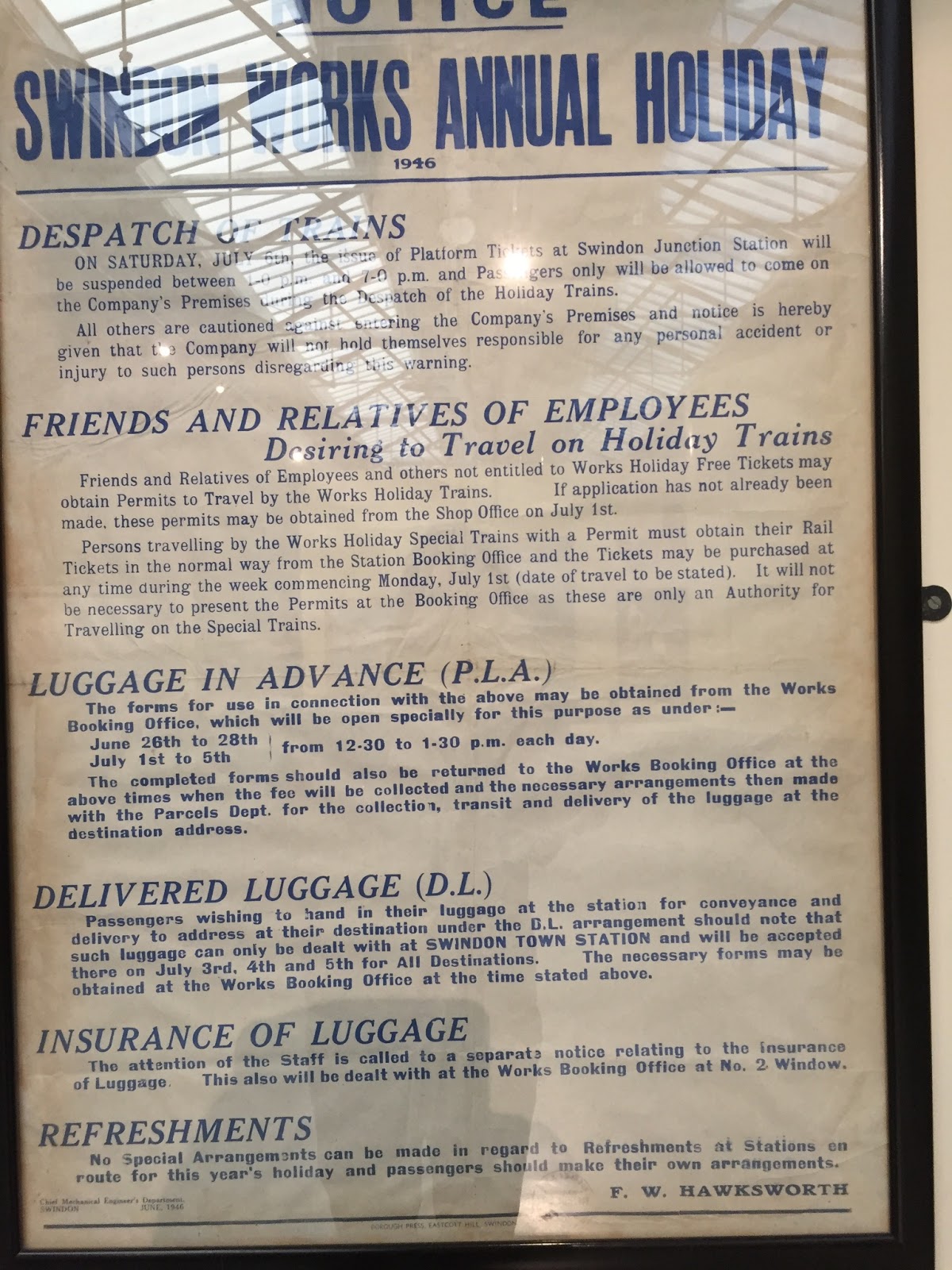
Taking notice

I loved the notices.


Phoros should be zoomable.

Saturday, 23 March 2019

Scenes from the museum

I spent Friday evening in the Red Deer, drinking Moonshine and scarfing veggie nachos, so here to keep you going are a few scenes that took my fancy from the Great Western Railway Museum.


Not as fascinating as a rogue apostrophe, I grant you, but you can't have everything all the time.

Friday, 22 March 2019

At a hundred yards...

I wasn't even looking, I swear. I was just walking past and something caught my eye; I thought 'something's not right there' and I had to turn back and look until I'd worked out what it was.
Proofreader woman. Never off duty. It's a blessing and a curse.


And yes, I am only too well aware that this blog is frequently very poorly proofread.

Thursday, 21 March 2019

A thought...

It occurred to me as I was walking to work today that thost three girls who starved to death in 1868 - Elizabeth, Mary, and Alice - were my great-great-aunts.

The same relation to me as Auntie Doreen is to Aurora.

Ninety-nine years separate Aurora and Doreen; 102 me and Alice. That's all.

Wednesday, 20 March 2019

Boilermakers

William George Hale was born on the 5th March 1860, to Stephen and Bethia Hale. Stephen was an agricultural worker at Worton, near Devizes in Wiltshire, and William was one of nine children.
This extract from the 1871 census shows five of them: Henry, Charlotte, William, Jabez and Arthur. Ezra, who would have been 21, was presumably living elsewhere. Elizabeth, Mary and Alice had all died in 1868 - Elizabeth aged 14 and Mary aged 11 from consumption, and Alice, aged five, from 'marasmus' - severe malnutrition. Malnutrition of course probably contributed to the deaths of the other two girls as well.

The following year, William and one of his brothers - presumably Henry, who up to that point had been an agricultural worker like his father - walked the twenty-two miles to Swindon to get jobs on the railway.

William was indentured, at the age of twelve and three-quarters, as an apprentice boilermaker.

These rather poor photocopies are from the Great Western Railway Loco and Carriage Dept Register of Apprentices' Indentures. Unlike some (who 'absconded' or were transferred elsewhere), William served his full seven year apprenticeship, seeing his daily wage rise from 10d in the first year to a respectable 3 shillings in the seventh - more, no doubt, than his parents could have dreamed of.

Having completed his apprenticeship in Swindon, somehow William ended up living in South London, married at twenty (in 1880) to a woman eight years his senior. Before long, however, he was back in Swindon, as the 1901 census shows:
 - he and/or Annie still lying about their relative ages as they did when they got married - and working as a 'Rivetter (Iron) G.W.R.' Someone - possibly my father - has added 'boiler' above this. Son George (George William, or William George Stephen - take your pick, but he was known as George) was at that point, aged fourteen, working as a grocer's assistant.

But by 1911, he was a 'plateworker' in the Swindon works, while his father, by now aged fifty-one, and with only another eleven years to live, was working as a frame builder in the wagon department. I guess boilermaking is a young man's game.
I don't have a date for this photo, but this is William in his Sunday best.

George, meanwhile, carried on working for GWR and in or around 1915 (family legend has it) was on a works trip to Jersey when he met one Irma LeLuan, a woman of his own not very tender age of thirty. Undeterred by the fact that she spoke no English, but only Jersey French, they married in 1916 and settled in Swindon, where she lived until her death in 1985 at the age of 99. That's my Grandma, and the only one of the characters in this story so far that I met.
Here's George in around 1921, with Auntie Doreen
And in 1947. He died in 1958 so I never met him.

Hence my interest in the boilermaking shop at the museum. Although both William and George may have spent much - even most - of their working lives in other jobs at the GWR Swindon Works, it seems pretty clear that they were both, at one time or another, boilermakers - a dirty, dangerous, high-pressured (no pun intended), highly-skilled and above all, deafening, job - and that's something I'm quite proud of.
It may of course also explain my love of rivets.