CHERTSEY

BOATS, BRIDGES, BOILERS ... IF IT'S GOT RIVETS, I'M RIVETTED
... feminist, atheist, autistic academic and historic narrowboater ...
Likes snooker, beer, tea, rivets and solitude, and is strangely fascinated by the cinema organ.
And there might be something about railways.
**********************************************************************************
Showing posts with label history. Show all posts

Wednesday, 22 September 2010

Sign of past times


One last Wolverhampton photo. Signs and fascias from the 50s and 60s are becoming rare now, and worth recording. I really liked this one. The shop was still there too, plying its trade.

Monday, 23 August 2010

Fill her up, sir?


Been having a bit of a clearout today. The number of things that we really don't need, but still feel we ought to hang on to, is diminishing. For example, I have finally decided to throw out two jigsaw puzzles that I have been carefully husbanding since about 1967. One of then depicts a headscarfed Mrs Rabbit, surrounded by little rabbit-lets, outside her home in a hollow tree, selecting fabrics from the hamper of a travelling tinker who, from his ears, is clearly an elf. This is simply not the sort of thing one sees any more, and I fear we are the poorer for it. If we find the missing two pieces, I shall keep it. The other features Noddy on a wooden train, with Big Ears as the guard, and has nothing to recommend it, really.

But one thing I do still feel obliged to keep, an ancient jumble sale find, is a pristine, never used, set of two-tone green overalls bearing the badge of the Regent Petrol Company. They are jolly smart, and very nearly fit me, being just a trifle over long in the extremities. I spent ten seconds in extensive research and uncovered, from this website that the Regent Petrol Co.:

was founded in 1947 following a merger between Texaco Petroleum Products and Trinidad Leaseholds. Prior to the war the Regent brand name had been used by a small distributor of motor spirit who had been taken over by Trinidad Leaseholds in 1931 and it was this name that the newly merged company used. 1953 saw the end of pooled petrol regulations and Regent began to broaden its operations by selling branded petrol in the UK. The company also had a tanker fleet and this expanded through its Texaco connections. Texaco had various North Sea interests including refineries etc. Texaco took full control of Regent in 1967 by buying out Trinidad Leaseholds and began to phase out the Regent brand in favour of the Texaco brand. Texaco also had other small brand names and in 2004 relaunched them all under the Regent brand where the familiar red white and blue branding can still be seen today.

I am sure I will find the right occasion to don my petrol pump attendant's overalls and wear them with pride... even if their advertising was a bit dodgy. Ahem.

Wednesday, 2 June 2010

Some wonderful photos

Thanks very, very much indeed to Richard Pearson for sending me these photos, and giving me permission to post them. All of them were taken by Richard Pearson, as were the ones I've already posted of Chertsey on the Edstone Aqueduct in 1973, and on the bank in 1986.

These two were both taken in 1970, and show Chertsey pretty much as when Richard Barnett bought it - as did that one on the Wey which I posted before. The tunnel bands (rather unusual?) are the same as in the 1964 Stratford rally as photographed by Max Sinclair.

This one again shows Chertsey (on the right) loading coal at Gopsall Wharf on the Ashby Canal, to be delivered to Croxley Mill.

This one (above) was taken in 1972, just prior to the cabin rebuild. Richard P. tells me that Richard B. had already acquired the oak by then, from Colne public library. This picture was taken just above Barton Lock, which was then the limit of navigation on the Upper Avon.

And this one shows Chertsey in 1978, with the new cabin well established. You can actually see the difference in shape, I think. Richard Pearson has confirmed that the oak framing of the cabin is original - perhaps the planked wood cabin follows the lines better than the previous ply one did. How many large Woolwiches have any of their original framing left, I wonder?

Finally, in 1986, Richard P. helped Richard B. re-rivet the knees after the major rebottoming:

Once again, many thanks to Richard Pearson for these. I hope to meet him soon....

Friday, 7 May 2010

Detective work

After poring for a while over that photo of Chertsey in the Roger Alsop book (and I've since had further confirmation that Chertsey was indeed there at the time), I decided to compare it with some of the few other photos I have.

The first one I looked at was this. This is Chertsey on the River Wey, on the way to or from the National Rally that year (I have the plaque too). I can be fairly sure this is the real thing, not only because of the plaque, but because I was given it by the Turners who got it from Richard Pearson, who was Richard Barnett's business partner. This is definitely the same boat as in the Harry Arnold Gopsall photos which I dare not reproduce. Even the Brasso tin is still there (though it has been moved from one side to the other). Has something awful happened to the tiller, or is that an optical illusion?

One thing that is fascinating me is the engine situation. When built, in 1937, Chertsey was fitted with a National DM2. In 1960, a Petter PD2 - the one we have just removed - was fitted. But the scars on the engine room roof suggest that at some point a third engine was fitted. This would have been prior to 1960, so might have been by GUCCCo or by BW (Ownership passed from the former to the latter upon nationalisation in 1948). I need to do a bit of digging to find out if and when GUCCCo started replacing engines - I know that information is out there and shouldn't be too hard to find.

But I am also intrigued by what I found in the pictures regarding the cabin. This much I know: Large Woolwich motor boats were built with wooden (softwood) cabins (unlike their Northwich equivalents, which were all-steel). BW's practice once the boats were in their ownership was to replace these (as they needed replacing or repair) with plywood ones, which lacked the nice lines of the Woolwich ones. At some point, Richard Barnett rebuilt Chertsey's cabin... from solid oak. The story has it that this wood was salvaged, in the form of shelving, from Colne public library. It was probably intended to function as a wooden cabin; it is double thickness. However (most likely, I guess, because it leaked) he had this solid oak cabin skinned in steel by Les Allen. That is the cabin it now has. But the photos (assuming I have their chronology correct) have thrown up some interesting questions about the cabin.

For example, in the Wey photo above, and in the Gopsall photos, you can clearly see that the cabin has side vents. These were standard in the Woolwich cabins, but I don't know if they were reproduced in the BW ply ones.

Now, here are two later photos, very kindly given to me by Richard Barnett's widow. The first, really beautiful, one (of which sadly I only have a rather poor print, which I have just scanned) was, she told me, taken in 1973. The second one I don't have a date for, but the style of clothing sported by Richard (for it is he) suggests that it is a little later.What intrigues me is that it clearly still has a ply cabin here - i.e. Richard hasn't yet got around to replacing it; perhaps he is just about to - and it is the same one as in the 1973 photo, but not the same as in the 1970 ones. How short-lived were they - would he really have replaced it twice between 1970 and the early eighties? Although it is possible, because it is now clear in the 1970 photos that the paintings inside the rear hatches are not the same as it has now, but by 1973, they are in place.
One further thought - I suspect - and, of course, like to think, that some of the oak framing inside Chertsey's cabin is original. At first I didn't believe this could be possible, but what made me wonder is the fixings revealed when we removed some moulding by the back doors - great brutal metal spikes. They just don't look like they would have been in use in 1970. Someone whose opinion on wooden cabins I would respect said he thought they could be original. And it does seem that the ply cabins were built on the original framing, so unless it was damaged (and it's 4x4, roughly, oak) there would be no reason to remove it... unless you were replacing the whole cabin with a steel one. A fate which Chertsey, I think thankfully, has avoided.

Saturday, 17 April 2010

Getting shut


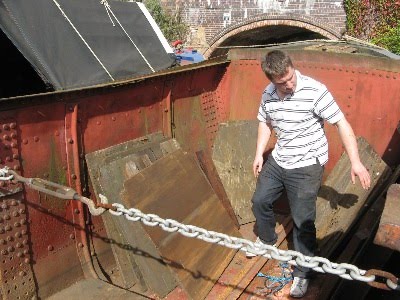
We're off again today and one of the first jobs will be to clear out Chertsey's hold. One of the things we sadly have no use for is what we believe to be a complete set of British Waterways issue plywood shuts from the 1950s. These were the modern alternative to planks in the bottom of the hold, both to raise the cargo above the level of any water in the hold, and to protect the bottom of the boat when unloading. Obviously the ideal would be to replace these like-for-like, but given the price of marine ply (and these are an inch thick) it would be unjustifiably expensive - and, to be honest, they're harder to handle than planks. They's also be a lot of work to make, as many are shaped to fit a specific part of the boat. So Chertsey will be reverting to old fashioned planks. But I thought I'd mention it, just in case there's anyone out there who's looking to make themselves a set and could use a pattern...

Friday, 12 February 2010

Monkey business

I took the opportunity on Wednesday to take a couple of (pretty dreadful, as they turned out) pictures of my monkey box.

Now, last summer, when we met Hawkesbury, newly bought, at Fradley Junction, and I got chatting with the steerer, when I told him I had just acquired Chertsey the first thing he said was 'You've got my monkey box!'. Indeed, when I first went and saw the boat, it was described as 'Hawkesbury's monkey box.' But it ain't. As far as I can gather, something like this, like water cans, would be the property of the boatman, not part of the boat, and this one certainly is, having heard its history and how it came to be in Chertsey. It was made by Roger Hatchard, when he did indeed have Hawkesbury, but when he swapped his G.U. for a josher it didn't fit, so he gave it to Richard Barnett for Chertsey, and it's come to me along with all the other odds and ends on board. It's nice for me to have something with a connection to Hawkesbury, as my surname is the same as the name of its original (official) butty.

To be honest it doesn't fit perfectly on Chertsey, it's crudely made [but see comments for clarification] and painted, but as a bit of history and a nifty hidey-hole, I love it. To be honest some more, until I saw this one I hadn't even heard of a monkey box, so I asked on CWF about their origins and uses, and a long and learned thread ensued. The general consensus seems to be that they were used for storing cleaning materials and rags, possibly because there was a particular brass polish called 'Monkey Brand'.
Looking at it through female eyes though I find this rather unconvincing. The monkey box (open at the bottom and at the back, though this might not be typical) sits on the side bed, tucked into the corner adjacent to the door.

It's a safe and relatively clean place; why waste that on storing cleaning materials which could just as easily be kept in the boot cupboard, under the side bad or even in the engine room? Furthermore, brass polish tends to come in bottles - and I think always has had - which would be too tall to store upright in the monkey box. One person suggested that an alternative name was 'pillow box', which severs the Monkey Brand brass polish connection, and - although I'm very prepared to be proven wrong if there's any evidence to be produced either way - I'd be far more inclined to think of it as a relatively safe, covered, clean place for storing treasured possessions. I admit that that is purely intuition, and I would love it if someone could come up with something conclusive to demonstrate their use - and indeed, how widespread they were.

In the meantime, I'm afraid I shall be keeping my little treasures in mine.

Friday, 29 January 2010

Happy birthday old thing

When Jim saw the Historic Ships Register certificate yesterday, the first thing he said was '1937? I thought it was built in 1936.'

Well, maybe it was, mostly. How long did it take to actually build one from start to finish? But the date I have for Chertsey's delivery to GUCCCo is January 29th 1937, so I have taken that to be the year the build was completed. And this then, if boats had birthdays which of course they don't, is Chertsey's seventy-third birthday.

This set me thinking - how were the boats actually 'delivered'? Did GUCCCo boatmen go and fetch them from Woolwich (and Northwich), or did the builders have the responsibility of bringing them to a GUCCCo depot? Were they delivered in batches - indeed, were they built in batches, and if so, how many at a time? - or singly? How were butties delivered or collected?

Wednesday, 27 January 2010

Someone else's pictures

Been saving this up for a night like this when I've not prepared a post and too tired to start thinking about it. A while ago Andrew of Dove posted this link on CWF - it's someone else again's wonderful old boat photos. I don't know who he is myself, but if he's posted them on the web then presumably he wants as many people as possible to look at them. To be honest, they are so wonderful I found it all rather overwhelming - an embarassment of riches - and haven't had a really good look yet myself.

The experts and anoraks at CWF have however given the matter their fullest attention and have issued a number of corrections to the captions and reminiscences, and a long thread has ensued.

Enjoy.

Tuesday, 26 January 2010

Chain reaction

I have been following Blossom's Minnow blog with enormous interest - it is quickly becoming a vast repository of information and memories and anecdotes that will surely be a treasured resource in years to come - not to mention right now.

I'm going to be cheeky and put in a request for Blossom to tell us about chimney chains... their purpose, origins and most importantly design and decoration. I have all these lovely brasses


and I want to know how to attach them to a chain - and what sort of chain it should be - for best effect.

Of course, I couldn't find a decent photo of a really good one (Plover has one, but it didn't show up properly in any of my photos), but any excuse for a picture of a cute dog.

I know the tale, of course, about chains being made from the brass fastenings salvaged from gas mask cases - and modern chains that you buy new with their flat links would seem to be based on this. But WWI or WWII gas mask cases? And in any case, what did they do before the relevant war? I'd have guessed that ordinary brass chain would have been used, but in that case, why does no one seem to use it today even on boats done up in earlier styles?

So much I don't know, but someone out there will have the answers.

Monday, 25 January 2010

United we rivet

It's my sister's birthday today - very neatly timed to be exactly six months (yes, and three years) from mine, and that reminds me that I promised to send her some photos of the wonderful colour lithograph certificate presented to our grandfather by the United Society of Boilermakers and Iron and Steel Shipbuilders in 1924, in appreciation of the work he'd done for them since joining in 1915. This is the grandfather - our father's father - who was a boilermaker on the Great Western Railway at Swindon.

It's been very hard to get a decent photo though, without taking it out of the frame (which I am certainly not going to attempt!); whatever I do I don't seem to be able to avoid getting very visible reflections in the glass.

I wish I could show you the real thing; it is stunning. The whole thing in its lovely gilt frame must be about two and a half by three feet. The colours and the detailed illustrations of the Society's work (relief of widows, help in sickness and old age) are wonderful.

The United Society of Boilermakers and Iron and Steel Shipbuilders (itself formed from the amalgamation of earlier societies) existed for over a hundred years, from 1852 until 1963, when it joined with the Associated Blacksmiths', Forge and Smithy Workers' Society and the Ship Constructors' and Shipwrights' Association to become the Amalgamated Society of Boilermakers, Blacksmiths, Shipbuilders and Structural Workers. This in turn amalgamated in 1982 with the General and Municipal Workers' Union to form the GMB Union, which went on to become part of Unite. It doesn't have quite the same ring to it does it. I got the history from this website.

For many years the certificate was on display at the British Engineerium, the former pumping station in Hove that was turned into a steam museum in the late 1970s. My father worked there after he retired, doing the books, taking round school parties (German speakers a speciality) and stoking the boilers. When he died I inherited a signed agreement that he had loaned it to them, which, fortunately, I kept very safe. A few years ago we read in the local paper that the Engineerium was to close, and that all the exhibits were to be auctioned. We dashed over, me clutching my piece of paper, to find Bonhams already setting up for the auction. One of the founders of the museum was there and was very loath to part with the certificate, insisting that it had been a gift! I waved the loan agreement - which actually might have been signed by him in person - as we fought our way out carrying my treasured inheritance, which now hangs proudly in the front room. As a postscript, the auction was called off at the eleventh hour when a local property developer 'saviour' stepped in. It was claimed then that the Engineerium would re-open, but it's been watch this space ever since.

While we're on the subject of my relatives, my cousin Tina (aka Yvette; she always had two names which I think reflected parental disagreement over what to call her; for ages I thought I had an extra cousin somewhere) has just restored Nelson's easy chair.

Tuesday, 12 January 2010

Chertsey: The known knowns

At least as far as we know...

Here at last, as promised, is a bit of background information about Chertsey. Most of it comes from The George and the Mary, AMModels, and other published sources, but I am also greatly indebted to Pete Harrison for providing me with a wealth more detail, some of which might creep in here. Any errors are more than likely my own, and I would be grateful to anyone who points them out.

So, to start near the beginning, it's the early thirties and canal carrying, at least on the Grand Union, is in a mood of buoyant optimism, not to say hubris, leading to an enormous expansion of the Grand Union fleet between 1934 and 1938. There were a few exceptions, but the majority of the motor boats were built either by Yarwoods at Northwich, or by Harland and Wolff at Woolwich (while butties were built by these builders, plus also some wooden ones by Walker Bros of Rickmansworth). Hence Northwiches, Woolwiches and Rickies, large and small (and in the case of Northwiches, middle). The first phase, between 1934-6 were 'small' and were loosely named after heavenly bodies, hence have subsequently become known as the 'Star Class', of which there were 78 pairs. Then from 1936-37, orders were placed for a further 86 pairs, with a deeper (a whopping four foot nine and a half inches) hold. These 'large' boats were named, in essence, after railway stations, and became known as the 'Town Class'.

Chertsey is one of these last, a Town Class Large Woolwich motor boat.

It was built as part of an order placed with Harland and Wolff for 24 pairs in February 1936, and was delivered to GUCCCo on the January 29th 1937, and given the name Chertsey and the fleet number 130.

Canal carrying in many parts of the country had been in trouble for some time, and some canals were becoming abandoned and derelict even before the war, but the G.U. seemed to be bucking the trend. It couldn't last however; having survived the expansion of rail transport better than many other waterways, it was no match for the expansion of road transport after the war, coupled with the exceptionally hard winter of 1947. In fact, only about 120 pairs were ever in service at any one time, even in its heyday. By 1948, when the waterways were nationalised, the writing was on the wall. The GUCCCo fleet, being directly owned by the canal company, automatically went with the canal into national ownership; it is a sign of how hard things were getting that Fellows, Morton and Clayton, the other great fleet, which was independently owned, voluntarily sold out to the Docks and Inland Waterways Executive the following year.

From this point on many boats were disposed of - sold to other operators, abandoned, sunk, converted to maintenance boats, transformed into parts of the British Waterways hire fleet, trip boats, or sold into private ownership. Chertsey however, remained in the British Waterways (as it became) carrying fleet until the early 1960s. It was finally sold by BW into private ownership some time between 1962 and 1964, and then appears to have been converted into a houseboat. This is the period about which we have least information, although Max Sinclair has posted photos of Chertsey at Stratford upon Avon in 1964 on CWF.

In 1969, Chertsey was purchased by Richard Barnett to become the first boat (and the only narrow boat) in what grew to be a fairly large and eclectic collection of working boats. It was clearly his intention to work it, and Chertsey must surely have been one of the earliest examples of a boat being deconverted as he restored it to a working state. I still know little about what Chertsey did under his ownership, but it included bringing coal from the Ashby Canal to the papermills on the G.U., and acting as a tug dredging on the Soar.

Chertsey with Richard Barnett - late 70s/early 80s?

By the early 2000s, Richard Barnett had become ill, and from this point - if not sooner - Chertsey was effectively abandoned. In early 2009, he died, and his executors began the daunting task of finding buyers for his boats - of which, of course, I was lucky enough to become one.

So that's a little outline of Chertsey's history, particularly regarding its ownership. There are boats that have had fewer owners over their lifetimes, but not many.

Monday, 4 January 2010

Sheriff of Nottingham

illustrated with a random photo of Nottingham

Before Christmas I went to visit my friend Dean in his new house in Brighton, and we went to the local church fete (you do that if you're a Londoner newly moved to the provinces). We got there just as it was winding down and got lots of bargains. I won a bottle of wine on the tombola, and bought a very large jar of pickled red cabbage (let no one say I'm not good to Jim), and on the bookstall, reduced from a pound to fifty pence each, six books by John Harvey. I'd read other books of his as part of my random library trawl and really enjoyed them - well written atmospheric thrillers with good, sympathetic characters - but these were even better - six of the ten books in his series featuring Nottingham detective inspector Charlie Resnick; a great police character, a loner with a liking for jazz, cats and messy sandwiches. I read them (six in a row - what a wonderful indulgence) over Christmas, and have ordered the other four from the library.

I don't know Nottingham well - I've been there a few times, but mostly only to the University, which is out of town, and we went through by boat last year, but the sense of place in the books is very evocative and accurately represented. The canal and the river get a good few mentions (and we will forgive him one reference to seeing a 'longboat'), but I was particularly fascinated by this brief extract from the final book in the series, Last Rites:

Romanticising [about the old terraces at Notts County, this was], Resnick knew, and as dangerous as the efforts to dress up the past and sell it sanitised that drew tourists to the Lace Museum and Tales of Robin Hood and even the Galleries of Justice, where for a few pounds you could inspect the old police cells and the tunnel along which deported prisoners were shepherded into canal boats on the first part of their plague-ridden journey to the colonies.

I've had a look at the Galleries of Justice website, but it doesn't mention this particular aspect of their offering. Has anyone been, or know anything about this practice?